Showing posts with label Grades 6-12 Lesson Plans. Show all posts

Wednesday, April 20, 2016

Create a calm classroom oasis in the chaotic testing month of May

April showers might bring Mayflowers, as the old pun states, but in today's classrooms, May blossoms with  a garden variety of testing, from Advanced Placement to End of Year, or Standards of Learning exams, or whatever name your. school district calls its tests.  Oh, yes, Make-Up Test Days also add rain on teachers' lesson plans, blurring their day's goals.  To add to the question, "How do we keep students on-task and working until the  'School's out for the summer" bell rings, most teachers are required to give-you know this to be true- a final exam!

With an individual novel study, teachers can guarantee that they are offering calm learning oases that will keep students on task as well as wanting to learn. This plan also requires them to be responsible for their assigned work. Best of all, it leaves the chaos out in the hall behind the closed classroom door.

Literary Analysis-MAKING the MOST of TIME  succeeds during those weeks when classes meet fewer times or have a number of scheduled interruptions to learning, such as extended testing periods. It is perfect for May because each day, many students may be absent due to testing, making teaching to the whole group difficult. In my district, the country-wide A.P. exams take up the first two weeks of May. On the day following the last exam, the state's Standards of Learning exams begin. They last until the end of the month and are followed by make-up days, which are crucial for seniors need another chance to pass, a graduation requirement. Teaching becomes catch as catch can for five weeks, creating stress for teachers and students. MAKING the MOST OF TIME keeps students on the Learning Train.

Here are a few suggestions that expand on the How to teach part of the Teacher Notes, the first page after the product cover. The Who, What, When, Where are self-explanatory. Teachers can read them and adjust the goals to their students' skills and abilities.

1. Hand out these packets a week or so before the testing schedule starts.  Not only will this give students the opportunity to choose the book they want to read for this project, and to start reading, but also it allows teachers time to ensure that every student understands the criteria, requirements and time table for this project before they start missing class because of scheduled tests.
2. Explain the parameters for the required books.  My first requirement is that they be novels or narrative nonfiction, like Into the Wild by Jon Krakauer. No How-To books, biographies, autobiographies, series of essays, memoirs or collection of poems are allowed.  Also, I set a minimum length of around 200 pages. Zora Neale Hurston's, Their Eyes Were Watching God is required for seniors and it's 184 ,pages, so I set the minimum page limit around there.
3. To keep the choices simple, for a class of 25 students, I select four each of 7-8 novels from the school's book room that I would love the kids to read but didn't have a chance to teach during the year.  To not infringe on my colleagues' literary territories and their grade levels, though, I keep to the level(s) that I am teaching that year- freshman, sophomores, juniors, seniors. I limit my selection to four of each title as I didn't want more than than that number of students to read the same novel.
4. If any of the students  are truly apathetic about the choices, teachers may allow them to choose the novel they would rather read, with parental permission, of course. Although  I really try to enthuse students about those that I chose,  my main objective is to try to turn those students I haven't reached, yet into literature lovers. As James Patterson said,

5. The last four bullet points under this section of the Teacher Notes  depend on each teacher's school testing calendar, how many of the assignments in this packet teachers want to include, and the skills and abilities of their students as well as the responsibility for independent work their students practice..
These next few images reveal the student directions, the first pages of the various activities and the project rubric.

Pages 3, 4 and 5 detail the directions.  It works well if teachers read these aloud while students follow, pausing for questions, answers, clarification when necessary.

Student Direction (3)Student Direction (4)

Student Directions (5)
Page 6 is where students jot down the notes they took while reading.

Notes Handout (6)


Page 7 and 8 show the Plot Chart and activity
Plot Chart (7)Plot Activity (8)

Page 9, 10 and 11 are for students' Quote Journals.  Because all of the pages follow the same format, I included only page 9.
Quote Journals (9)


Page 12 is for the Theme segment of this project.
Theme Activity (12)


Page 13 is the all-important Grading Rubric.
Rubric (13)


The key element to the beauty of this unit is that students create their schedules for completing the work after the teacher sets the Due Date. The May calendar that each teacher hands out to the class should show that every day the class will either read for half of the period, or work on the packets for half of the period. The other half of the period the whole class will either work on a facet of writing or will be divided into groups to discuss various aspects of the chosen novels. For the latter activity, the groups should be comprised of students who have each read a different novel. suggestion: change the groups every day so students encounter a wide range of viewpoints and analytic thought.

Each student designs his/her own schedule for the first half of the period, showing whether he/she will be reading or working on packet assignments.  Teachers choose the second half of the period activity, depending on how many students are present that day, and how many are absent due to testing.

By managing their class time wisely, students will only have to complete the typing and compilation of the required activities at home right before the final packets are due. They should bind all of the components of their packet together in some way - a folder with pockets is best.

Teaching time won’t be interrupted and chaotic because of testing, when this unit plan becomes students' May learning keystone. Its effectiveness stems from dual factors - students hold the ownership for what they are learning and when they are learning. 

More details to aid you as you make May bloom with reading, writing and thinking are included in the course description or this unit. https://www.teacherspayteachers.com/Product/Literary-Analysis-MAKING-the-MOST-of-TIME-681650. ($)


And you, my teacher friends, will appreciate the fact that your students are challenging themselves intellectually with these substantive activities as they increase their reading comprehension, and their higher level thinking and writing skills with and no loss of learning continuity. 


Enjoy a Teach It Now Day Every May Day,


Sunday, January 17, 2016

It's time for 'The Academic Awards for Literature'!


This morning, I was reading The Washington Post's  Book section and saw that The Martian by Andy Weir, The Revenant by Michael Punke and Brooklyn by Colm Toibin all made the top paperback book sales for last week. Why did these titles ring an, "Aha!" bell in my not-quite-caffeinated-enough brain? Because  just this past week, I read their titles on the Academy Award nominations list for Best Motion Picture of 2015.

Other books turned into movies that made the nominations list in that same category as well as others -some in multiple categories- are The Big Short by Michael Lewis, Room by Emma Donahue, Carol - based on The Price of Salt by Patricia Highsmith, The Danish Girl by David Ebershoff, Trumbo by Bruce Cook, 45 Years - based on In Another Country by David Constantine, and Fifty Shades of Grey by E.L. James.

Although many of these books will never be read in the secondary classrooms, some might. The point is- without the original books, these movies never would have been made. This thought made me wonder, "What about literary awards since so many films begin with an already published fiction or non-fiction piece?" 

literature analysis
Students would select their choices for The Academic Awards for Literature  from books they either studied as a class or read independently. It doesn't matter if the book they choose has never been made into a film. They have read enough novels and narrative nonfiction and viewed enough movies to form opinions as to which ones earn the label of the Best.

Would they vote for Mockingjay by Suzanne Collins? The Stranger  by Albert Camus? One Flew Over the Cuckoo's Nest by Ken Kesey? The Great Gatsby by F.Scott Fitzgerald, or one of many other solid choices? 


For this activity, teachers build on the Academy Awards nominations chatter to hook Middle and High School students' interest as they write about their reading. The Academic Awards for Literature absorbs students’ interest and motivates them to combine their opinions with facts and details from books as they create their awards and defend their choices.
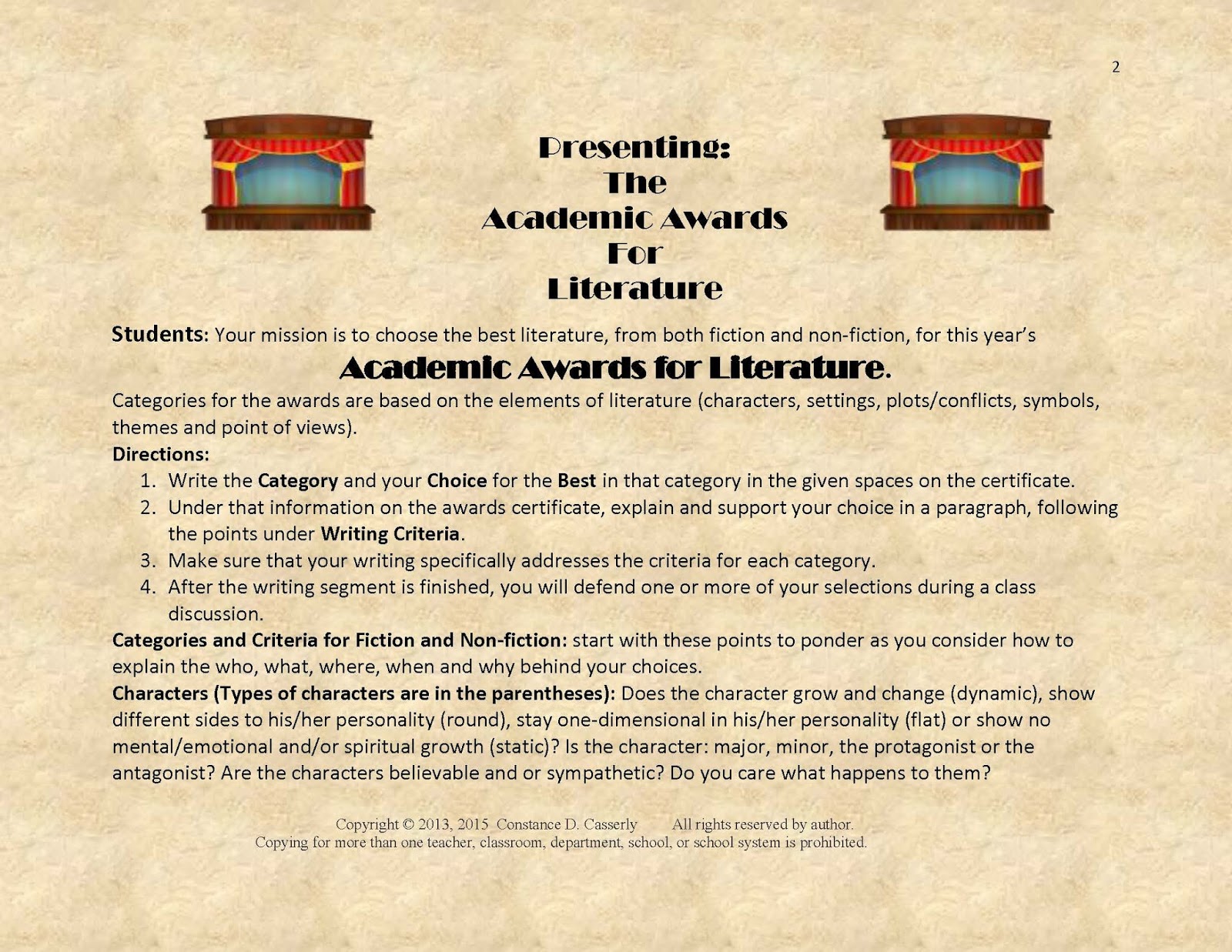
                                          Literature Analysis Student Directions p.2
The categories for the awards are based on the elements of literature - Characters, Settings, Plot/Conflicts, Symbols, themes and Point of View.

To complete this lesson, students are required to
1. write the category title and their choice for the Best in that category in the given spaces on the certificate.
2. explain and support each choice in a paragraph on the awards certificate, following the points under Writing Criteria. 
3. make sure that their writing specifically addresses the criteria for each category. 
4. defend one or more of their selections during a class discussion.

 
Literature Analysis Student Directions p.3
Literary Analysis Student Directions p.4


The criteria for Fiction and Non-fiction offers students points to ponder about each element of literature as they consider how to explain the who, what, where, when and why behind their choices.


Example: Characters (Types of characters are in the parentheses): Does the character grow and change (dynamic), show different sides to his/her personality (round), stay one-dimensional in his/her personality (flat) or show no mental/emotional and/or spiritual growth (static)? Is the character: major, minor, the protagonist or the antagonist? Are the characters believable and or sympathetic? Do you care what happens to them?

Literary Analysis p.6

After they choose their recipients for each award students are to fill in the certificates. Here are six of the twenty categories
•Best Fictional Female Character
•Best Fictional Male Character
•Best Supporting Fictional Female Character
•Best Supporting Fictional Male Character
•Best Non- Fictional Female Character
•Best Non-Fictional Male Character
In their explanatory paragraphs, students must state the award recipient as well as the title and author of the text. To defend their choices, the explanations must include three examples along with supporting details that justify each choice and that add clarity to the reasoning behind it.
The Teacher Notes page lists the Common Core Standards that pertain to this activity as well as the Bloom's Taxonomy terms students will utilize. 
                                           
Literary Analysis teacher Notes p.5

For another engaging activity for books that have been turned into movies, try - https://www.teacherspayteachers.com/Product/Literature-Analysis-Activity-Comparing-Books-and-Movies-32844 ($1.25)
Literature and Movie Analysis Activity


These lessons mesh reading, writing and viewing into activities that are guaranteed to ignite lively discussions where students support their opinions with facts and details. Who knows- someday one of their book choices might be turned into a movie, and they will hear their choice  introduced during the 20_ _ Academy Awards  with the words, "And the winner is...".

Enjoy a Teach It Now Day Every Day.