Showing posts with label Language Arts Lesson Plans. Show all posts

Monday, September 29, 2014

Flesh out Characters with Three Analytic Activities

Fall Into Character Analysis


Fall Into Character Analysis
I have always been intrigued by the people that I have met between book covers. Exploring how these fictional beings act and react to the people and the conflicts that they encounter have always fortified my understanding of humans, their passions and their ambitions.

This interest is why so many of my products focus on the character aspect of the elements of literature.  Fall Into Character Analysis adds even more depth to this emphasis.

Three handouts – “Island Odyssey," Fleshing Out Character" and  “It’s a Halloween Party" offer middle and high school students opportunities to reveal their comprehension of the characters they are studying.  Through writing and speaking, they will explore a trio of the basic motivations that propel authors to create dynamic, round individuals.
  1. Who and what determines how characters deal with their thoughts, feelings and emotions?
  2. What factors determine how characters interact with the people they meet and the situations they encounter?
  3. Why do they act and react to these internal and external conflicts in the manner that they do?

Students will show their understanding of character development by choosing specific details to complete each teacher-selected activity. They will select their answers based on the information that they have gathered in their reading.

Teachers should introduce these activities during and after the latter part of the rising action - or when enough information about the characters is present for analysis.

As students complete these assignments, they will exhibit their range of thinking skills from knowledge through evaluation. They will also show their understanding of character development as well as their analytic and critical-thinking oral and writing skills.

Individual and/or small group options will work successfully, although “It’s a

Halloween Party” is better suited to individual responses.  As with all of my activities, the students should share their responses during whole class discussions.
Fleshing Out Character
Download this Language Arts Activity

Don't plan during your personal hours- Download. 
Give yourself the gift of time with these ready for class lessons.


Happy Teaching,


Monday, July 7, 2014

English Language Arts Lesson Plan - "Conflicted by Conflict"

English Language Arts Lesson Plan - "Conflicted by Conflict"
Frank Sinatra was famous for crooning, "I did it my way." The characters in the stories students are studying should sing the same lyrics. 

This English Language Arts Lesson Plan, "Conflicted by Conflict" will enable middle and high school students to show how a character of their choice from a story that they are studying should respond to a conflict that appears in a different venue, i.e. movies, another book, a news piece, a song lyric on a contemporary life situation.

For each venue, the students will:
1. Summarize How the Conflict is Revealed in that selection
2. Reveal the character’s Antagonist in that specific genre
3. Show the Character’s Action/Reaction to this conflict.

Students should use details from the story they are studying to support their character’s response(s) to the conflict as it is shown in the new venue. 
Here's an example how they can accomplish this:

Story The Hunger Games Author Suzanne Collins
Another Book/Story Into the Wild by Jon Krakauer
Character: Katness Everdeen Antagonist The wilds of Alaska
Conflict: Katness faces dying from starvation due to the isolation and hardships of an Alaskan winter (Character vs. Nature)
Character’s Reaction:
Katness Everdeen’s understanding of poisonous plants would have saved her if she had been faced with starvation like Chris McCandless. Because she had spent years foraging for food for her mother and sister, she never would have mistaken the toxic sweet pea vegetation for the safe wild potato plant. Also, as a savvy and accurate hunter, she would have been able to trap or kill animals for much needed protein.

In Conflicted by Conflict, middle and high school students will flesh out characters from their reading to show their understanding of the element of character as well as their analytic and critical-thinking skills.
English Language Arts Lesson Plan - "Conflicted by Conflict"
 English Language Arts Lesson Plan - "Conflicted by Conflict"

By analyzing a character of their choice, students will exhibit their understanding of this person’s characteristics, emotions, and other attributes through comparing and contrasting his/her actions and reactions to the same conflict, but which exists in other literary and life venues 

This activity should be introduced when the characters have shown enough depth to analyze. Although both Common Core Standards and active verbs from Bloom's Taxonomy Learning Domains are included, you should use these given standards as guidelines, adapting them to the benchmarks that your state follows.

We teachers often wonder what are students actually know and understand from their reading. The singer, Alesana addressed the understanding necessary to make a decision in her song, "Second Guessing"
'Tell me are you second guessing?
Because you honestly seem to have it all
Are you under control or questioning how this all ends?'

After they complete this activity, students will feel confident about the character that they have evaluated, and will proudly say, "No second guessing for me. I have it under control."
Download it from http://www.teacherspayteachers.com/Product/Comprehension-Writing-Activity-Conflicted-by-Conflict-1310733
 As with all of my products, this one includes detailed Teacher Notes.
English Language Arts Lesson Plan - "Conflicted by Conflict"


Happy Teaching,


Teach it Write
Building Powerful Academic Homes

Monday, June 23, 2014

Language Arts Activity - Characters Just Keep on Dancin'

Language Arts Activity - Characters Just Keep on Dancin'
No matter their age, students love music and dancing. In this FREE handout, Language Arts Activity - Characters Just Keep on Dancin, Middle and High School students will select characters from the literature that they have studied throughout the year for a dance competition.

They are to reveal their comprehension of these characters’ personalities, emotions, and moral fiber in their writing and speaking.

This language arts activity should be introduced when the characters have shown enough depth to analyze. Students will flesh them out by showing their understanding of the element of character as well as their analytic and critical-thinking skills. 

Here are the Students' Directions:


Language Arts Activity - Characters Just Keep on Dancin' Students' Directions
Students- for this activity, you are to
1. Choose three pairs of characters (6 characters, total) to team up for a dance competition (Based on the Dancing With the Stars Television show). 
2. These characters may be from any stories that you have read in class this year. Do not be concerned that the dancers in each pair are from the same setting or historical period. Also, the characters in each pair do NOT have to be from the same story. 
3. Each pair will compete against the other two pairs, so your choices for each duo must have similar dancing skills and abilities.
4. Once you have chosen your pairs, you must explain the reasons for your selections, and defend your explanations with details from the stories that support your thinking. Be sure to analyze each duo’s competitive dancing strengths and weaknesses.
5. Next, choose the type of dance (Ballet, jazz, hiphop, disco, fifties-or any decade, etc.), and the music for each pair’s competition dance. The music must fit the dance genre as well as each dancer’s skills and abilities.
6. Choose three criteria that the dancers must meet-examples: Technical Merit, Difficulty of Routine, and Showmanship. Ten points should be allotted to each of the criteria, and the pair that wins must earn the highest score out of 30 points. NOTE: You will have to go back and score each pair’s dance routine after you select the three criteria.
7. Select the winning team. Here you will have to justify your choice by determining how each pair met the set criteria. Write each analysis in sentence form.
8. When you are finished, the teacher will divide you into teams of three. Here, you will read the analysis and decision of your two team members. Finally, you will show whether you agree or disagree with that peer’s choice by writing an explanation on that student’s paper.
9. Finally, write a brief news item for the Entertainment Section of an online or print newspaper revealing the Who, What, Where, When, Why and How of this dance competition.
10. Teachers will collect the papers and grade them according to their pre-set criteria, i.e details, supporting material, analytic depth, grammar, spelling etc.
11. Teachers should have you orally share your choices and justifications.
12. At the end of this part of the activity, the teacher will collect the papers.

This product supports Common Core Standards and Bloom's Taxonomy. Use the given standards as guidelines, adapting them to the benchmarks that your state follows.

Students' brains will boogie to the learning beat with this FREE activity. When the music flows and the characters dance, students will be engaged and motivated. Download Language Arts Activity - Characters Just Keep on Dancin' from http://www.teacherspayteachers.com/Product/Comprehension-Writing-Activity-Characters-Just-Keep-on-Dancin-1288466


Language Arts Activity - Characters Just Keep on Dancin' DAncer and Music Selection
Language Arts Activity - Characters Just Keep on Dancin' Team Member Analysis


Happy Teaching,


Monday, June 16, 2014

Language Arts Activity - Oh My WORDs!

Language Arts Activity - Oh My WORDs!
Vocabulary study will become meaningful to Middle and High School students when they make the words an integral part of their writing and speaking. We teachers must offer them a variety of ways to think about the word’s definition, as well as its connotative meaning so that they can make logical inferences about its usage.

The key to word ownership is to offer students a variety of opportunities to use the words repeatedly in order to remove any aura of isolation that remains when they just memorize the meanings for a test. This multiple exposure will help the students become more comfortable and confident with how to use the words.

Like my Vocabulary: 31 Ideas for Teaching Vocabulary
(http://www.teacherspayteachers.com/Product/Vocabulary-31-Ideas-for-Teaching-Vocabulary-634378),  this FREEBIE, Oh My WORDs!,  also has 30 exercises for students to show that they understand how the vocabulary words should be used in context. 

In their writing, students will have to actively think about four elements in order to use them correctly: the word’s definition, its contextual and or connotative meaning, its part of speech, and which, if any, inflectional endings (i.e. –er, -ed, -ing-, s) are necessary when they include them in this piece. 

Language Arts Activity - Oh My WORDs!
Through this reinforcement, each student will add some of the words to his or her oral and written language repertoire.  Reading comprehension will also improve, not just due to the inclusion of teacher-generated words into their personal vocabularies, but also because they are learning to think about how writers choose words to express their thoughts.

I have grouped the exercises as: Warm-ups Writing, Short Writing, and Shared Writing. For the most part, the topics are general enough to be used in conjunction with any word list. Students should complete the Warm-up Writing in 15-20 minutes and the other two categories in twenty-five to thirty minutes. My intention is not to turn these into major writing assignments, but to offer enough depth for the students to develop their thoughts and to include as many words as they could without turning the writing into a contextual word list.

Teaching Idea:

To insure that the students are studying how the words are used and are not just memorizing the meanings, assign a Short Writing the night before the quiz.  The day of the assessment, collect the writings, put them in a stack on your desk, and, while the students are completing the quiz, check off that they are complete.  You can review these pieces quite quickly if you choose to only circle any words that are used incorrectly or are unclear. 


When the students have turned in the quiz, they should choose a peer’s Short Writing and write their reactions to the content of the piece.  Have them underline any vocabulary words that they use in their 100-150 word responses for extra credit. When the time is up, stroll through the room, check that the assignment is completed and note any extra credit that you may add to their quiz grade.


Happy Teaching,

Monday, June 9, 2014

Language Arts Activity - Fiction's Physique

Readers enjoy rating the books that they read whether this analysis occurs in their heads, on line, with a friend or in book group discussions.

Language Arts Activity - Fiction's Physique
This English Language Arts activity- Fiction's Physique- enables Middle and High School students to develop their comprehension and reasoning skills as they show- in writing and orally- a story's buff or flabby qualities.

Teachers should offer this lesson after students have finished reading the story. When they have completed this activity, students will reveal the buffness of their thinking skills from knowledge through evaluation.

This activity allows them to show their understanding of all aspects of the Elements of Strong Fiction as well as their comprehension of the various aspects of the story.
Here is the How the lesson should be taught from the Teacher Notes:

·         Introduce the activity by reviewing each Element of Strong Fiction (Vivid Details, Depth of Character, Descriptive Settings, Captivating Plots, Realistic Dialogue, Unpredictability, Originality, Emotions, Believable Endings and Purpose).
1.       Before class, write each of the ten elements on the board, leaving space for student responses.
2.       Give each student a card with one of the ten elements written on it.
3.       Allot them five minutes to find an example of their element and to write it on the board under the corresponding topic.
4.       Discuss the answers
·         Review the activity’s directions by reading them orally and then checking for understanding.
·         Give students time in class to work on this activity.  Suggestion- 30 to 45 minutes, depending on their skills and abilities.
·          Students may either finish this activity in class the next day or as a homework assignment. Teachers choose their desired option, depending on their students’ skills and abilities and their objective(s) for the activity.
·         The day that the activity is due, write the elements of strong fiction on the board again, randomly assign each student two topics, and then ask them to write one of their examples under each of their assigned elements.
·         Alternate Lesson: divide students into pairs or trios. Give them class time to complete this activity, instructing them to divide up the elements as they choose. Follow the previous bullet for sharing.
·          Each student must complete the Fitness Analysis segment.
Language Arts Activity - Fiction's Physique
 Language Arts Activity - Fiction's Physique


Happy Teaching,


Monday, June 2, 2014

Language Arts Activity - You & Me: Mirror Images or Polar Opposites?

Language Arts Activity - You & Me: Mirror Images or Polar Opposites?
Sometimes students meet characters that seem like their alter-egos; other times they feel that these people are their polar opposites. 

In this FREE Language Arts activity, You & Me: Mirror Images or Polar Opposites?, Middle and High School students choose the character from the story that they are currently studying or from any book that they studied in class this year with which they most identify.

Here are the directions for each aspect of this multi-layered lesson:


Directions Part 1: Choose the character from the story that we are studying or from any book that we
studied in class this year with which you most identify. Fill out the following by comparing and contrasting your similarities and differences with this person.

Language Arts Activity - You & Me: Mirror Images or Polar Opposites?
 Language Arts Activity - You & Me: Mirror Images or Polar Opposites?

In this part of this packet, each student is to relate the physical, mental, emotional, spiritual and moral similarities and differences between the character that he/she chose and him/herself.

After they complete this, they evaluate their information for the qualities that they are glad that they share with the character, those that they never want to share, and those that they wish they shared.

Directions Part 2: Use your information from Part 1 of this activity as notes for the following essay outline. 
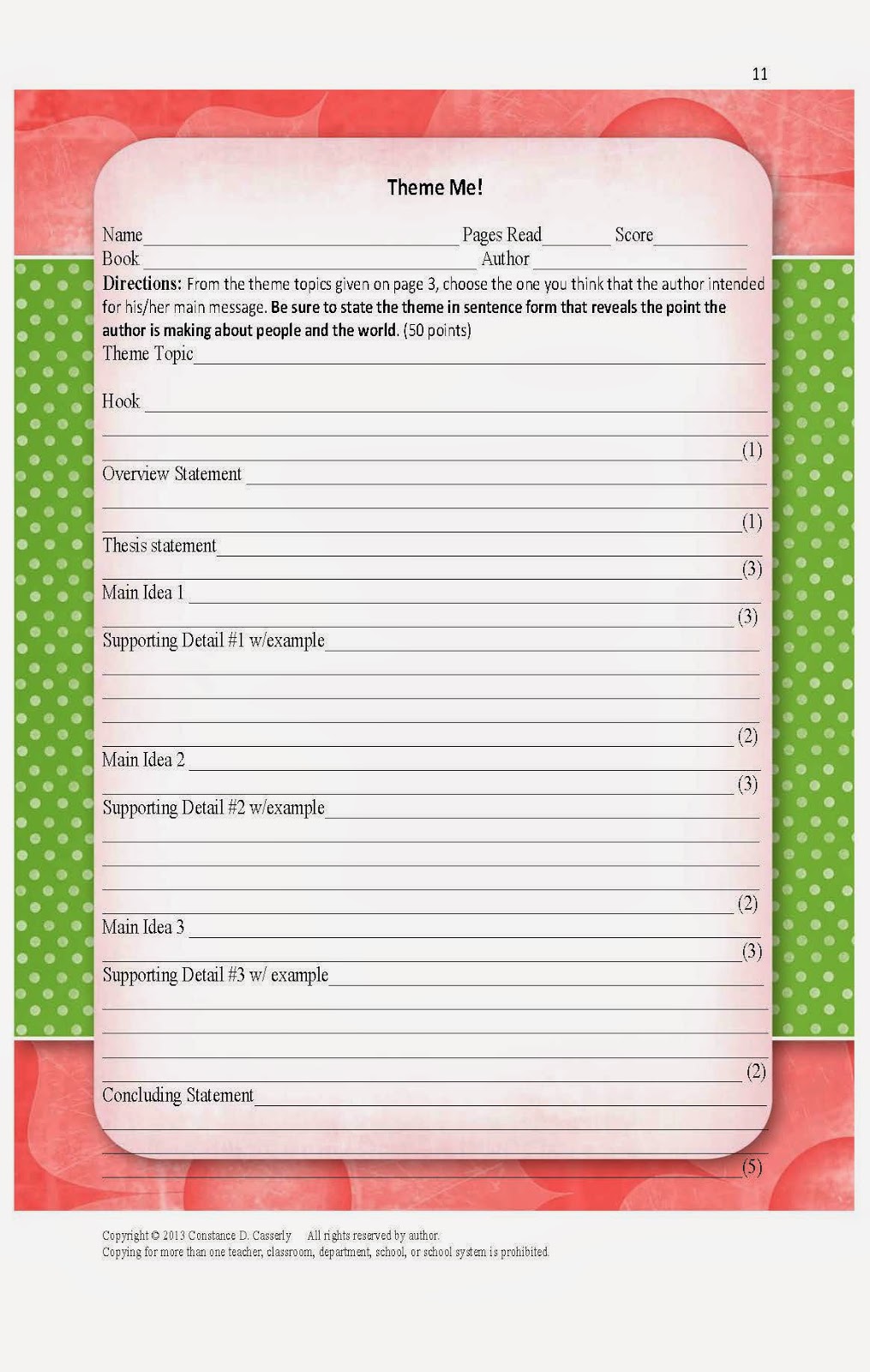
After you complete this page, use your Hook, Overview Statement and Thesis Statement to begin a full-length essay showing 
• how you are similar to and different from the character that you chose, and
• how you feel about these similarities and differences.
Detail your main ideas, backing them up with specific facts and opinions from the book and from your own thoughts to develop this essay. 

Language Arts Activity - You & Me: Mirror Images or Polar Opposites?
Essay Criteria:
1. Minimum 500 words; no maximum- write until you have fully developed your points.
2. Type your essay – double-spaced- in the font style and size set by your teacher.
3. Essay Packet: Behind the final typed draft of the essay, attach all of the Part 1 and Part 2 pages of this activity.

Teachers, use this comprehension-developing lesson with the study of any story, or as a culminating end-of-the-year assessment. By the time that they have completed the notes, outline and essay, students will have exhibited their range of thinking skills from knowledge through evaluation. 

Also, this activity allows them to exhibit their understanding of all aspects of the character element of literature as well as their analytic and critical-thinking skills.

Best of all, they will figure out if this character is their mirror image or their polar opposite.

As always, specific standards and Bloom's Taxonomy choices are included in the detailed Teacher Notes. Download this FREE activity from http://www.teacherspayteachers.com/Product/Comprehension-Character-Activity-You-Me-Mirror-Images-or-Polar-Opposites-1263319
 

Happy Teaching,


Monday, April 28, 2014

Language Arts Lesson - Making the Most of May

Due to the scheduling of various standardized tests, i.e. A.P testing and individual state assessments, May can be a difficult month to keep students inspired and the learning momentum smooth.

Language Arts Lesson - Making the Most of May
The anxiety that might crop up as teachers plan around the Testing Calendar will abate when they use this middle and high school English lesson plan. With this unit, students’ not only choose the novel that they will study,  but they also create a daily reading and writing calendar that works with their scheduled exams and the teacher’s due date. These factors maintain a flexible and flowing learning environment that engages students and promotes responsibility.  

Students select a book of their choice to read and complete the detailed activities included in the packet.  


These requirements involve a
1. General Novel Packet with four aspects: Book Notes, Plot Diagram, Quotes and Theme worksheets
2. Full-length Essay (500-750 words)
3. Group Project: "Threads-Making Connections"
 
Every day the students will either

  •  read for half of the period, or
  •  work on their packets for half of the period.

The second half of the period, they will
  •  participate in a whole class writing session, concentrating on a facet of writing, or
  • discuss various aspects of their chosen novels with peers. NOTE: Each student in the group should be reading a different novel. Members take notes. These will enable them to complete the Threads-Making Connections activity.

By managing their class time wisely, students will only have to complete the typing and compilation of the required activities at home right before the final packets are due. They should bind all of the components of their packet together in some way - a folder with pockets is best.


Teaching time won’t be interrupted and chaotic because of testing when you let this unit plan become your May learning keystone.  Its effectiveness stems from dual factors - students hold the ownership for what they are learning and when they are learning.

Teachers do need to
  • specify minimum length, genre and anything else you deem necessary for your charges.
  • Mentor students’ progress with mini-conferences


And you, my teacher friends, will appreciate the fact that your students are challenging themselves mentally as they increase their reading comprehension, their higher level thinking and their writing skills with substantive activities and no loss of learning continuity.

Download Language Arts lesson - Making the Most of May from http://www.teacherspayteachers.com/Product/Language-Arts-Lesson-Making-the-Most-of-May-681650 


Happy Teaching,


Teach it Write
Building Powerful Academic Homes

Monday, April 14, 2014

Language Arts Activity - Message "The Meaning is in the Words"

Language Arts Activity - Message "The Meaning is in the Words"
Figurative language enriches our reading and listening adventures and adds depth to our understanding of the piece. 

In my latest Middle and High School English lesson plan,
Language Arts Activity: Message - The Meaning is in the Words, students explore similes, metaphors, personification, sensory imagery and hyperbole in the stories that they study in class.

They exhibit their understanding for the types of figurative language with their selections to analyze, and deepen their comprehension with their explanations. 


This Activity has three parts:

Part A: Find three examples of each of the following literary terms. By the type of figurative language, copy the passage that you chose along with the page number. Next, explain its meaning.

Part B: Your Turn - Create your own figures of speech. Make each one fit the people, setting or plot of the book that you are studying in class, and

Part C: Closure: Address each of the following questions.
1. Which type of figurative language do you find the easiest to identify? Explain your response.
2. Which type of figurative language do you find the hardest to identify? Explain your response.
3. Which type of figurative language do you like the best to create? Why?
4. Which type of figurative language do you like the least to create? Why?


Language Arts Activity - Message "The Meaning is in the Words"
          Language Arts Activity - Message "The Meaning is in the Words"
Language Arts Activity - Message "The Meaning is in the Words"
           Language Arts Activity - Message "The Meaning is in the Words"

This standards-based and Bloom's Taxonomy aligned language arts lesson encourages middle and high school students to decode the meaning in the author's words, and to find the message in passages that are often confusing. 

Download this lesson and detailed Teacher Notes from 


Teach it Write
Building Powerful Academic Homes

teachitwrite.blogspot.com logo

Monday, April 7, 2014

Language Arts Activity - Review It!

Language Arts Activity - Review It! cover
Students love to share their opinions about anything school, family, friends (and foes), community and world related. Review It! - a lesson plan for Middle and High School students - offers them the opportunity to develop their reasoning and logic skills as they write a review for a book that they have just finished studying in class. 

Best of all, they share their opinions with the world by publishing this piece on the book's page on amazon.com or barnesandnoble.com. 

In this language arts lesson, students will show their understanding of the elements of literature as they analyze the strengths and weaknesses of the story as well as the piece’s intent and whether or not it met this purpose. They will choose direct and indirect citations from the story to support their points. 

Review It! should be introduced after students have completed the reading. This activity enables students in grades 6-12 to exhibit their range of thinking skills from knowledge through evaluation. Their writing will demonstrate their understanding of all aspects of the elements of literature as well as their analytic and critical-thinking skills.

This packet includes:
A. 6 reviews from amazon.com - 2 each for The Hunger Games (Suzanne Collins), Divergent (Veronica Roth) and Twilight (Stephenie Meyer)- for students to read, analyze and discuss
B. A Review Check List to use for the discussion of the Amazon reviews and for their original writing.
C. The Review It! handout that details the directions for this activity as well as the points that students must cover in their reviews.
Language Arts Activity - Review It!


Review It! offers Middle and High School students an opportunity to practice how to share their opinions through effective analysis.

Download this activity that promotes strong reading comprehension, writing and higher level thinking skills from http://www.teacherspayteachers.com/Product/Language-Arts-Activity-Review-It-1197160.


Happy Teaching,


Teach it Write
Building Powerful Academic Homes