Showing posts with label 10th grade. Show all posts

Saturday, July 21, 2018

Class Matters Coming Soon


DAYS AWAY FROM LAUNCHING: CLASS MATTERS

Since I am always concerned with What Teachers Want besides What Teachers Need, whenever the chance arises, I ask classroom colleagues these two questions. Although a fine line exists between Want –desires for a  satisfying  career- and Need- what is necessary for a successful career, all too often during a school term, we teachers know the lines cross instead of remaining parallel. Statisticians rely on quantitative answers. Me? I prefer qualitative knowledge - what I learn from my colleagues. The following list reveals  some of the answers to years of asking, “What do teachers Want?”.  I have compiled  CLASS MATTERS: Planning, Teaching, and Managing Secondary Classes to meet the wants and needs of my classroom colleagues leading students in grades 6-12.

1. Students should come to school ready and excited to learn.
2. I would be a happy camper if students completed their homework on time. I assign it so they can increase their knowledge, and so I can see how I can help them understand what we are studying.
3. Oh, to never again hear, “Oh, that’s right. We’re having a test today. Well, I forgot to study.”
4. When I ask for their thoughts and analysis, I don’t want students to answer what they think I want to hear. I want them to think and to share their thoughts.
5. What is  most aggravating is that it’s usually the kids who don’t turn their work in on time who complain when I don’t hand their papers back the very next class. How is this respectful?
6. Can they please, please get to class on time? It’s not fair to the others when I have to repeat what I have already covered.
7. Although my colleagues and I work together to follow the criteria set by the Program of Studies and how to weight our grades, we have different class rules., and that should be respected by students, colleagues, administrators and parents.
8. Students need to understand that school rules are in place for their safety and well-being and to create a positive and courteous learning environment. Running in the halls, texting, listening to music on their IPods, or whatever, foul language and dressing inappropriately for school are detrimental to this goal.

9. All I ask is that students just try in each aspect of school life, be it academic, social, behavioral, or extra-curricular areas.

Not only does this collection include handouts and printables to meet  both your wants and needs in these three areas, but it  offers posts that suggest how, when and why the  various  focuses will be most useful to you.  Although  some of the information here is self-explanatory to rookie and veteran teachers,  other ideas become clearer with  a short discussion. And sometimes …sometimes we just need  enlightenment on how to use  a new item because we just. don’t. have. a. free. brain. cell. to. think. about. it.

This 100 page teacher resource is divided into sections: Planning, Teaching, and Managing. Within each segment I have interspersed blogs to show  teachers  how to efficiently create lesson plans, classroom rules, and behavior standards. Numerous teaching ideas , handouts and classroom management forms will  meet many of your wants and needs. In the final pages, I invite you to take a break from all of your planning and organizing, and to kick back and relax with  two posts: A Labor Day Lesson: A Contemporary Tale, and In Defense of Teenagers.

Stay Tuned, and remember- 
CLASS Matters, and CLASS MATTERS always matter.

Connie


Tuesday, September 16, 2014

Six Additional Activities for Arthur Miller's The Crucible


No matter how much we love our activities for a literature study, sometimes we crave
Comprehension & Writing - Additional Activities for The Crucible
more lessons to engage our high school students. This 14-page packet, "Comprehension & Writing - Additional Activities for The Crucible," offers six more activities you can add to your repertoire.

Pre-Reading
"Anatomy of a Witch Hunt" - Directions – Each of you is responsible for detailing one of the teacher-assigned topics on this list. Only facts will be accepted. Write your findings in the spaces by your topic. Write one of your facts in the space provided for your topic on the large sheet of paper taped to the wall. When it is your turn to share, if the fact that you chose has been used, select another one. Initialize your fact. Finally, take notes about the other topics in the provided spaces on this sheet. Use the back of this paper, if needed.

"Anatomy of a Witch Hunt""Know Their Roles"
During the Reading
"Know Their Roles" - Directions
Part 1 - As you read and discuss this play, for each of the following characters, explain his/her MAIN ROLE in the plot. After that, copy a quote made by each person (include the page number) that shows his/her beliefs and feelings about the situations that occur. 
Part 2 - Write each name in the Protagonist, Antagonist or Neutral box. Be ready to defend your choices.
"Easy Target-Darts"
 "Easy Target-Darts"

"Easy Target-Darts" -Directions – Consider the people who were accused and convicted of practicing witchcraft. Write each one’s name on the flames of one of the darts. Next, cut out the darts and glue each one to the bull’s-eye target. Place the hardest to convict in the outer circle and move toward the center, with the easiest in the red bulls-eye. Be sure that the point of the dart is in the correct circle. Write your reasons for your choices on the Easy Target-Defenses sheet. You do not have to use all of the darts.
"The Truth or A Lie? That is the Question" - Directions– Before you consider which characters in The Crucible are lying and which are telling the truth, address the following thoughts about lying in the spaces provided.
The Truth or A Lie? That is the Question
 Lies! Lies! Lies!

"Lies! Lies! Lies!" - Directions – Which characters are lying? Why? Choose which of the characters listed here are Lying, Telling the Truth or if you are Not Sure. Write each character’s name in one of the columns, and then briefly state how you arrived at this conclusion. Remember that the characters in the play do not see/hear everything like the reader does. Use the back of the paper if necessary.

Post-Reading
"Emotional Fuel – That Was Then" - Directions
Part 1 - The following factors all affect the thinking, speaking and, actions of the people in
Emotional Fuel – That Was Then
The Crucible. Each one propels the plot by fueling the intolerance and hysteria of these times. Choose three of them, as well as a character that is motivated by the issue, and detail how their choice drives the plot.
PART 2 - "Emotional Fuel –This is Now" - Directions: discuss two of the above factors that influence people's thinking, speaking and actions in contemporary times. Give examples from current events that defend your choices.
Part 3 - Could a witch hunt occur in the United States now or are enough safeguards in place to keep this from happening? Support your answer with facts from current events as well as your own interpretations of these situations. Write your explanation on the back of this sheet of paper.

Plus, in the detailed Teacher Notes, I offer a number of lesson suggestions -and the link- for using Arthur Miller's piece that was originally printed in The new Yorker- , “Why I Wrote The Crucible- An Artist’s Answer to Politics".

Engage your high school students and give yourself the gift of time with these six lessons for Arthur Miller's "The Crucible". 

Download this packet from
http://www.teacherspayteachers.com/Product/The-Crucible-Additional-Comprehension-Writing-Activities-1450756 ($5.00)


You can download my original 53-page unit plan for The Crucible from  http://www.teacherspayteachers.com/Product/The-Crucible-Unit-Plan-1617

Happy Teaching, ($19.95).

Monday, March 31, 2014

Language Arts - What's So Important? A Coordination and Subordination Activity

Language Arts - What's So Important? A Coordination and Subordination Activity cover
When trying to show the importance of ideas, speaking tends to be so much easier. Word choice- along with the chance to instantly replace words for clarity- a tone of voice that expresses which ideas are emphasized, and even the speaker's body language work together to create sentences where thought coordination or subordination are evident.

Writing, though, is much more difficult. The writer has many rough drafts, but one final opportunity to demonstrate which thoughts show coordination, and which ones reveal subordinate ideas.

For example, maybe I want to show that Zelda's and Bubba's responsibility about homework is the same. I would write, "Zelda and Bubba both turn in their homework ninety percent of the time."
(I bet that their teacher is happy with this excellent data!)

But what if I want to emphasize that Zelda is more responsible than Bubba? I might write, "Although Zelda is conscientious about always meeting homework deadlines, Bubba is undependable about completing his assignments.

That information in that sentence is correct, but the emphasis is on Bubba's lack of responsibility because this idea is in the Independent Clause- always the clause that shows the most important idea.

This activity, "What's so Important? A Coordination and Subordination Activity" offers Middle School and High School students three different activities to practice showing What is So Important.


Language Arts - What's So Important? A Coordination and Subordination Activity p.4Language Arts - What's So Important? A Coordination and Subordination Activity p.5Language Arts - What's So Important? A Coordination and Subordination Activity p.6


What's So Important? A Coordination and Subordination Language Arts Lesson is aligned with the Common Core standards and Bloom's Taxonomy, but will easily meet the needs of individual state's benchmarks.

Middle School and High School students will find that their verbal and written misunderstandings will diminish when they master "What's So Important".


Your students will be thrilled when you, "Please don't let us be misunderstood." 

I paraphrased these words from the song written by Bennie Benjamin for Nina Simone (1964) and also sung by The Animals (1965), and Santa Esmerelda (1977).

Happy Teaching,


Teach it Write
Building Powerful Academic Homes


Monday, March 24, 2014

Language Arts Activity - Tripping Through Time


Tripping Through Time Activity coverIn this 4-page Free activity, Tripping Through Time, students use their thinking and writing skills to show their understanding of the character, conflict and other elements of literature in the piece that they are studying through narrative writing. 

As the character of their choice from the reading, they are transported to a totally unfamiliar time and geographic area. After researching this different time and place, the students will write a personal narrative comparing and contrasting both societies. Their responses must reveal the point of view of the character that they chose to personify, not their own.

The students’ completed writing will show their comprehension of the reading, of the material that they gathered in their research, and they will strengthen their higher level thinking skills.


Download this FREEBIE from http://www.teacherspayteachers.com/Product/Language-Arts-Activity-Tripping-Through-time-1174672


Happy Teaching,


Teach it Write

Building Powerful Academic Homes

Teach it Write logo

Sunday, March 9, 2014

Language Arts Activity - "Predicting Outcomes"


Language Arts Activity - "Predicting Outcomes" coverAll people, real and fictional, have experienced the Woulda, Shoulda, Coulda dilemma at least once in their lives. With this FREE lesson, Language Arts Activity - "Predicting Outcomes", students dig into this Choice/Consequence quandary that a specific character experiences throughout a story. 

The chart that students complete for this activity will show the round and dynamic qualities of the character as well as how the person  acts and reacts to the Plot/Conflict.

Introduce this activity during the latter part of the Rising Action or when enough information about the character has been given. In completing it, students exhibit their range of thinking skills from knowledge through evaluation. 

The written segment allows them to show their understanding of all aspects of the character elements of literature as well as their analytic and critical-thinking skills. The oral response/discussion aspect enables students to exercise and develop their speaking and listening skills.

This Common Core aligned activity has students, remembering, thinking, applying, analyzing,

Language Arts Activity - "Predicting Outcomes" activity
writing, evaluating and speaking. Their motivation is tweaked  by the age old, "Woulda', shoulda', coulda'" dilemma.

Download this FREE activity from http://www.teacherspayteachers.com/Product/Language-Arts-Activity-Predicting-Outcomes-1152153. The Teacher Notes page details the Who, What, When, Why and How for this lesson as well as the selected Common Core Standards and Bloom's Taxonomy choices.


Happy Teaching,


Teach it Write
Building Powerful Academic Homes

Monday, March 3, 2014

Language Arts Activity - "Taking a Break"


Language Arts Activity - "Taking a Break"

Language Arts Activity - "Taking a Break cover

Just a moment ago, I turned my back to my window as a chill ran up my spine.  Why?

Because it is March 3rd and the "...weather outside is frightful," (From Let it Snow). Here in the suburbs northwest of Washington, D.C., snow in falling, and falling, and falling.  The wind is circling the street hunting for a face to face confrontation. Like the vast majority of the country, we are experiencing yet another Weather Event, this one bears the name,Titan.

Although  all of the school districts in a 50+ radius of my home office are cancelled today, many of you, my teacher colleagues, have splashed, slid and pushed a path into your classrooms for the first Monday in March. What do you do when those lessons that fanned your teaching flames in the fall and that kept your teaching passion warm during most school days of this endless winter now seem as drab lifeless as the arugula on that tuna sandwich you squeezed onto the top shelf of the Teacher Lounge fridge last Friday?

If it's impossible to actually pack your bags and set off for a sun-soaked sandy beach along with a few good friends, at least take a mental break. 

Ask your students to envision their own Fantasy Vacation mental break, too, but instead of enjoying themselves with a few of their real friends, they are hanging out with three fictional characters.

This engaging lesson is a terrific Any Time During the Year Recap to assess your students' comprehension, understanding and analytic skills of the material that they have read so far this school term, On dreary days when  any R & R seems far, far away, it offers a needed getaway for your students- even if they are only jet-skiing through their heads. 

For this activity, students will decide on traveling companions for their dream vacation. They will ask three characters from books that they have read for school assignments this year to join them on this fantasy trip. 

  • Who will they take? 
  • Why them? 
  • Where will they go? 
  • How will these people help them have a perfect trip?
Students must detail their responses to these questions so the reasons behind their choices are clear.Their explanations for these selections must reveal which physical, emotional and personality traits made them desirable trip mates.

Escape Storm Titan. Let your mental meanderings take you away to your dream getaway with some interesting and novel companions.

Download this FREE activity, with detailed Teacher Notes, from
http://www.teacherspayteachers.com/Product/Language-Arts-Activity-Taking-a-Break-248681

Happy Teaching,


Enjoy this an hundreds of other free and priced lessons on
 http://www.pinterest.com/TheBestofTPT/free-lessons-priced-lessons-the-best-of-teacher-en/


Monday, February 24, 2014

Literature Task Cards

Literature Task Cards

Language Arts: Literature Task Cards
This product offers teachers a set of Elements of Literature Task Cards when they want their students to

  • reinforce, 
  • review and 
  • develop their understanding of a text, and to 
  • work on expanding their comprehension/higher thinking skills and /or writing aptitudes.

The elements of literature: Plot/Conflict, Character, Setting, Theme, Symbols, Tone and Point of View as well as a set titled, My Insights, are each represented by six color-coded task cards that reveal questions for students to explore their comprehension of the text. The points that they address cover:


  • Understanding/ Remembering 
  • applying knowledge 
  • analyzing ideas 
  • evaluating situations
  • characters' actions, and 
  • composing original pieces based on the text.
Literature Task Cards-Character
Literature Task Cards-Symbols
Literature Task Cards-My InsightsLiterature Task Cards-Plot/Conflict
These cards are beneficial for individual, small group or whole class study and discussion, for in-class writing and for homework. 

Inspire your students to build powerful academic homes with these 48 Language Arts Literature Task Cards.


Download this engaging product from http://www.teacherspayteachers.com/Product/Language-Arts-Literature-Task-Cards-1131263

Happy Teaching,


Teach it Write
Building Powerful Academic Homes

Monday, February 17, 2014

Language Arts Activities - "Writing About Reading"

Writing About Reading

Language Arts Activity - "Writing About Reading
A folder that we teachers love to feed is the one where we collect topics for writing about reading.  We can never have too many ideas to students to write when their brain isn't sparking any thoughts, or when we want them to write to a prompt. My newest set of activities,Writing About Reading, offers teachers two new activities

  Language Arts Activities - Writing About ReadingLanguage Arts Activities - Writing About ReadingLanguage Arts Activities - Writing About Reading

  1. "Quotation Journals: What did the character say?  What did the character mean?" Note: this is terrific for nonfiction pieces as students can explore the author's point of view, tone, etc., and
  2. Writing Journal Topics  Note: 30 writing ideas.

Language Arts Activities - Writing About Reading
As with the majority of my product, a Teacher Notes page details the Common Core Standards and Bloom's Taxonomy objectives that apply to this packet. It also explains What is being taught, WhenWhy and How regarding Writing About Reading.

Students can use these for Warm-Up writing, after a discussion to reveal their understanding, for a short answer assessment (the teacher selects a topic), for a small group discussion, for a, "Who Said That?" quotation review game, as a class closure assignment, for homework, or for whatever teachers think would fit the needs and abilities of their students.

When students have the chance to Read text, to Think about it, to Write about it and then to Speak about what they read and wrote, they will remember so much more about what they are studying. At the same home run!


Download Writing About Reading from my TpT store http://www.teacherspayteachers.com/Product/Language-Arts-Activity-Writing-About-Reading-1118924

Thank you to The 3AM Teacher for the wonderful Free borders-http://www.teacherspayteachers.com/Product/Free-Frames-Backgrounds-by-The-3AM-Teacher-196582

Happy Teaching,


Middle School Lesson Plans, High School Lesson Plans, Language Arts Lessons, Writing Lessons Reading Comprehension, Writing Skills, Thinking Skills

Monday, February 10, 2014

Language Arts Activity – “C’mon in to My House”

C’mon in to My House

Language Arts Activity – “C’mon in to My House” cover
Every house has a story. Every student has a number of  stories. In Part 1 of this product, Language Arts Activity – “C’mon in to My House,” students will relate the details of one situation that took place in their current home, or another where they have lived. They will use the elements of literature to guide their thinking and writing.  After this, they will analyze how these elements form the framework of a family and their home.

In Part 2, students will follow the same directions, but this time, with a character from the story that they are studying. At the end of this segment of the activity, students will analyze how all of the elements work together to build a story’s structure, just like they work together to compose a family and their home.

For each segment of this activity, students will also draw the floorplan for the homes that serves as the setting for that part, and will include the characters that played a part in the situation. They should add any other embellishments that they feel are integral to the situation, and which help illustrate their summaries.

Language Arts Activity – “C’mon in to My House”

This activity requires students to touch on each of the five parts of the Bloom’s Taxonomy wheel: Remember/Understand, Apply, Analyze, Evaluate and Create. It is also aligned with Common Core Standards, which may be adapted to a state’s specific standards.

After they complete this activity, students will understand, and be able to discuss how the composition of their family and home, and  the framework of a story are connected by the elements of literature.

As always, a Teacher Notes page that provides the Common Core and Bloom's Taxonomy standards and includes the What, When, Why and How to Teach details is included.

Download this Language Arts activity from http://www.teacherspayteachers.com/Product/Language-Arts-Activity-Cmon-in-to-My-House-1107073


Happy Teaching,


ELA Middle School Lesson, ELA High School Lesson,  Elements of Literature,  Analytic Writing, Expository Writing, Bloom’s Taxonomy,  Common Core Standards

Monday, February 3, 2014

A Novel Idea to Celebrate President's Day


 Hail to the Chief Activity cover
If a character from a novel could be the president of the United States, who would you choose?  Who would your students choose?

This project is a great way to engage students in a presidential campaign, an inauguration, or to celebrate President's Day in February. For this project, each student chooses a character from a novel to run for President of the United States. 

This character can be from a book they read in class or from their independent reading. All information that the students include must reveal the author's presentation of this character as well as the student's analysis and interpretation of the person. 

Students will create a whole campaign for this character.
Criteria: 

  • The requirements to be covered are detailed on the first page of this handout. 
    Hail to the Chief page 3
  • Final Project Format- Students choose one of three options
    • a PowerPoint presentation 
    • a webpage presentation 
    • a Poster Board presentation
Standards:
  • All of the facets of Bloom's Taxonomy: comprehension, application, analysis, synthesis, evaluation and knowledge are addressed. 
  • This activity focuses on the  Common Core Standards for Literature: R 1, 2, 5, 8 W 1, 2, 4, 5, 6, 9 SL 1, 4, 5 L 1, 2, 3, 5, but teachers may choose their state's corresponding standards. 

The project should take a month to finish if all of the suggested writing is required. Teachers should alter these requirements to fit their time frame and their students’ skills and abilities. Students may start it in class and complete it for homework. If teachers want to spend a shorter time on this project (1-2 weeks depending on class time/homework time allotted for completion), they can divide the students into groups of 3-4. Each group will decide on a character to run for President and will divide up the required work into equal parts.

If time permits, a final Speaking and Listening activity could be a debate between two characters with the
Hail to the Chief Activity p.4
most opposing views. For projects done individually, each student whose character is chosen can present his/her material and argue the issues. If either character chosen was a result of a group project, the members of the group can decide who presents which material. In this case, each student should have equal time.


* Page 2 offers detailed Teacher Notes.
Download this President's Day activity from http://www.teacherspayteachers.com/Product/Activity-Hail-to-the-Chief-192533

Which character will each of your students choose to be the next 
President of the United States?


Happy Teaching,


Monday, January 27, 2014

Valentine's Day Activities Duet - "Characters + Conflict = Comprehension"

Love may be entwined hands, an arm in arm stroll on a sunlit beach or a conversation showing forgiveness.
The desire for love might fan the flames of revenge, loneliness or fury.

With this Valentine's Day duet of activities, students will bolster their reading comprehension by analyzing character and conflict in the literature that they have studied in school.

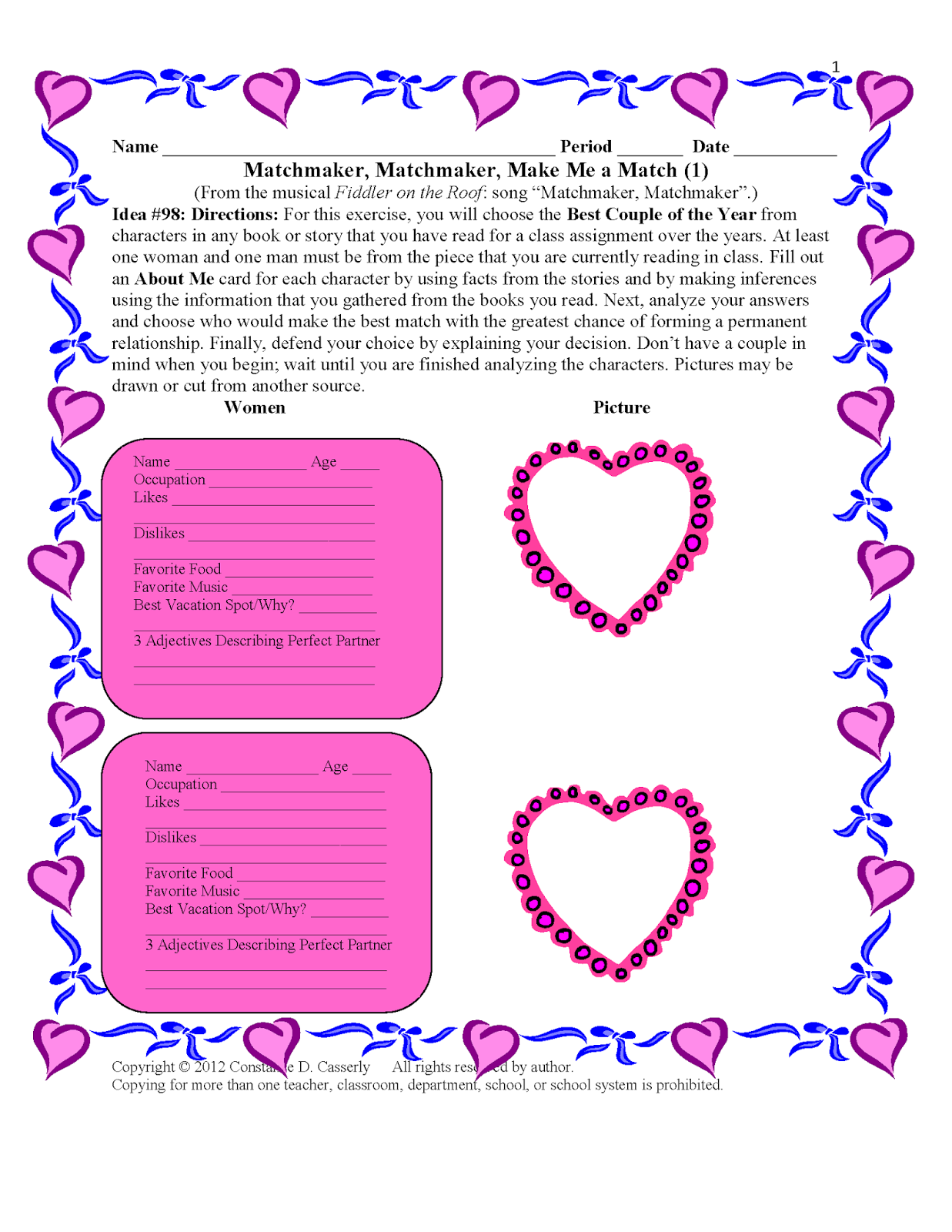
Activity: Matchmaker, Matchmaker, Make Me a Match

 For this Valentine's Day Freebie, students will choose the Best Couple of the Year from characters in any book or story that they have read for a class assignment over the years. At least one woman and one man must be from the piece that they are currently reading in class. 

Students complete an About Me card for each character they choose by using facts from the stories and by making inferences using the information that they have gathered from the books they read. Next, they analyze their answers and choose who would make the best match with the greatest chance of forming a permanent relationship. Finally, they defend their choices by explaining their decision. 

This is a fun way for students from grades 5-12 to show their reading comprehension and critical thinking skills.

Total Pages 3  Answer Key  N/A  Teaching Duration  1 hour


Activity: Valentine's Day- You Sent What??? Cards

Valentine’s Day isn’t always an occasion showcased by happy hearts, aromatic bouquets of flowers and luscious boxes of chocolates. Because of various conflicts, peoples’ words and actions might be prompted by feelings of revenge, sadness and selfishness instead of forgiveness, joy and giving. 

In this activity, Valentine's Day You Sent What??? Cards, students must consider the characters and their conflicts in the fiction or non-fiction work they are currently reading or in any other literature that they have read this year in school (teacher’s choice). 
Their finished project will show how these characters would handle Valentine’s Day.

A Teachers Notes page lists the Common Core Standards that fit this activity, as well as the Bloom's Taxonomy terms students will utilize to complete the project.  A Student Directions page details the assignment.Valentine's Day You Sent What??? Cards allows students to increase their comprehension levels by combining their understanding of the character and conflict elements of literature with higher level thinking skills.

This engaging activity will appeal to a wide cross-section of students, from grades 5-12.


Total Pages 4  Answer Key N/A Teaching Duration2 Days


These two activities will increase students' comprehension homes, will keep them loving learning and will create smile after smile for teachers and students.

Happy Teaching,